
Should I Replace my Challenger Panel?
Maybe.
Unlike Federal Pacific and Zinsco panels, Challenger panels are not generally considered an automatic replacement.
That said, there are a few things worth understanding if you have one.
Many Challenger panels installed in the 1980s and 1990s are still in service today. Some continue to operate without issue, while others have reached the point where age, capacity, or condition make replacement worth discussing.
As with most electrical equipment, the answer depends on what you're looking at.
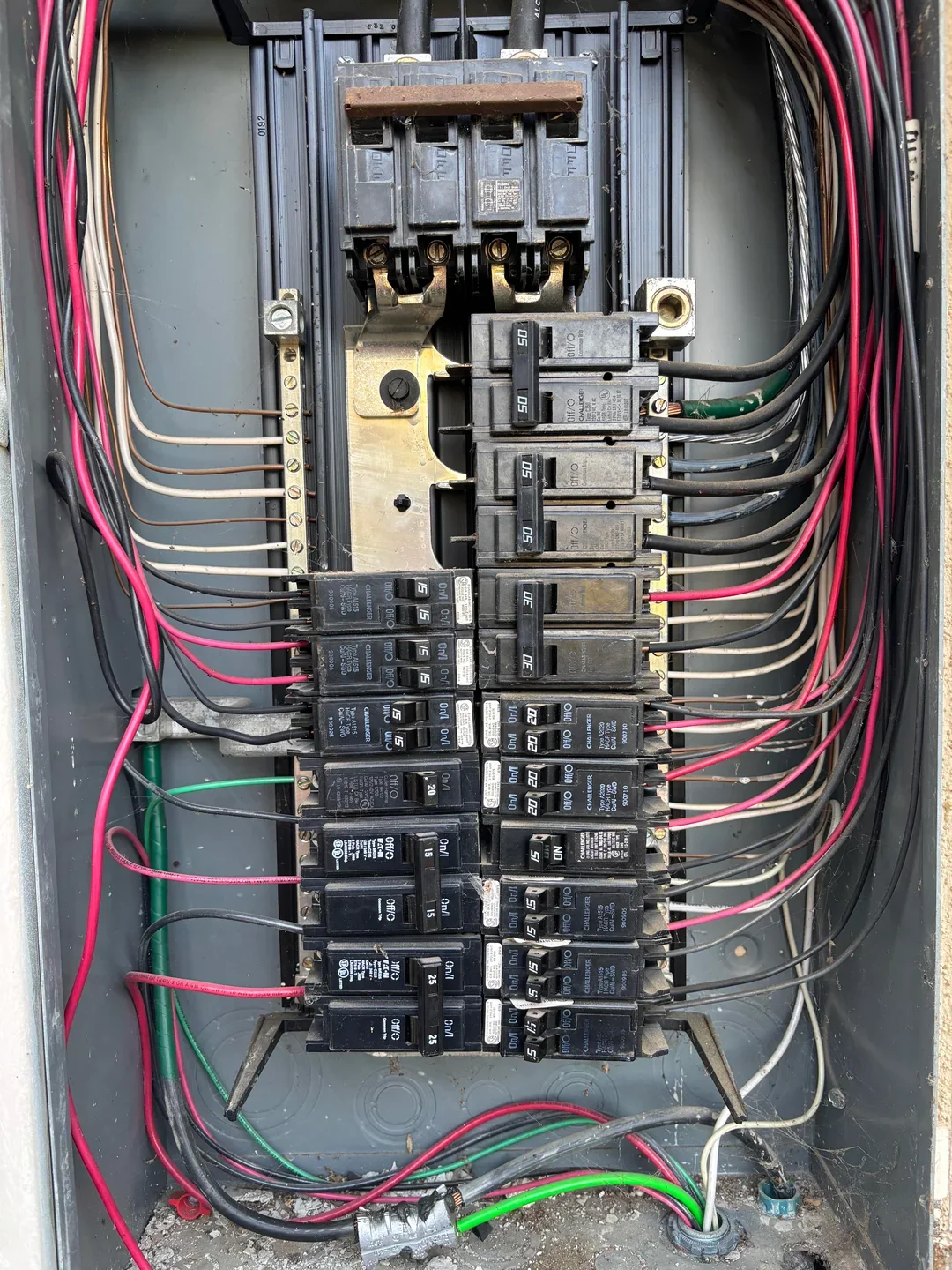
What Is a Challenger Panel?
Challenger electrical equipment became popular throughout the 1980s and early 1990s.
If your home was built during that time, there's a good chance you've seen one.
The good news is that most Challenger panels don't carry the same reputation as Federal Pacific or Zinsco equipment.
The bad news?
Most of them aren't getting any younger.
What Was the Problem With Challenger Breakers?
The concerns surrounding Challenger equipment primarily involved certain breaker models rather than the panel itself.
Some Challenger breakers were subject to recalls and safety concerns related to overheating and failure issues.
As a result, electricians often pay close attention to the condition and age of the breakers installed within the panel.
It's important to understand that not every Challenger panel contains recalled breakers.
And having a Challenger panel does not automatically mean replacement is required.
The Good News: Replacement Breakers Are Still Available
One of the biggest advantages Challenger panels have over many older systems is that replacement breakers are still readily available.
Modern Eaton BR breakers are listed and approved for use in many Challenger panels.
That's a big deal.
Unlike Pushmatic panels where replacement parts can become expensive or difficult to source, Challenger panels often have a practical path forward when a breaker needs replacement.
For many homeowners, this significantly extends the useful life of the panel.
Age Still Matters
Even when replacement breakers are available, age eventually becomes part of the conversation.
Most Challenger panels are now 30 to 40 years old.
Over time, electrical equipment experiences:
Heat cycles
Mechanical wear
Corrosion
Loose connections
General aging
A panel doesn't need to be dangerous to be approaching the end of its useful life.
Sometimes it's simply showing its age.
Capacity and Modern Electrical Demands
One of the biggest reasons we replace Challenger panels today has nothing to do with recalls.
It's space.
Homes have changed dramatically since the 1980s.
Many homeowners now want:
EV chargers
Hot tubs
Whole-home surge protection
Generator connections
Home offices
Finished basements
Workshop equipment
A Challenger panel that was perfectly adequate thirty years ago may simply not have enough room for today's electrical needs.
When Should You Consider Replacement?
Replacement may be worth discussing if:
The panel is completely full
You need additional circuits
You're planning a remodel
You want whole-home surge protection
You need AFCI or GFCI breaker upgrades
The panel shows signs of overheating or damage
You have recalled breakers that need attention
In many cases, homeowners discover the limitations of the panel during a renovation rather than during a failure.
So Should You Replace It?
If your Challenger panel is in good condition, has available capacity, and isn't showing signs of overheating or damage, replacement may not be necessary.
If it's full, heavily modified, showing signs of age, or you're planning significant upgrades to your home, replacement may make sense.
The panel itself isn't usually the reason.
The question is whether the panel still meets your home's needs.
The Bottom Line
A Challenger panel is very different from a Federal Pacific or Zinsco panel.
This usually isn't a conversation about a known fire hazard.
It's a conversation about condition, capacity, and long-term planning.
And thanks to the availability of listed Eaton BR replacement breakers, many Challenger panels remain serviceable long after other vintage equipment has reached retirement age.
The trick is figuring out whether yours still has plenty of life left—or whether it's time to start planning for what's next.
Stay legendary.
